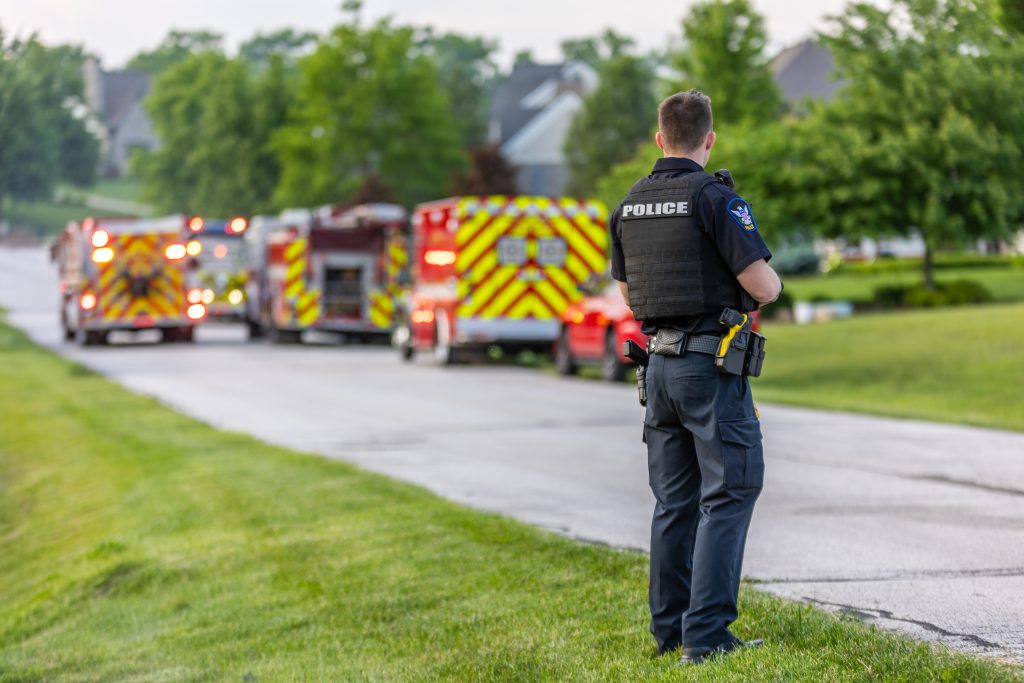
First responders don’t just witness trauma—they absorb it. Repeatedly. Over years.
In Canada, research shows that up to 44 per cent of public safety personnel screen positive for one or more mental health conditions, compared to roughly 10 per cent of the general population.
These are the individuals Canadians rely on in their most critical moments—the people who show up without hesitation when others cannot.
And yet, many of those who need support the most never ask for it. Why? Because of something less visible, but just as powerful: self-stigma.
In 2026, Mental Health Week’s theme “Come Together” is a reminder that support isn’t just about making services available. Rather, it’s about creating environments where people feel able to use them.
The weight behind the work
For paramedics, firefighters, police officers, correctional officers and dispatchers, the demands of the job go far beyond long hours or high-pressure situations. They include repeated exposure to trauma, unpredictable environments, life-or-death decision-making and the cumulative toll of witnessing others at their most vulnerable—often experiencing the worst moments of their lives.
Over time, that exposure adds up. But within many first responder cultures, there is an unspoken expectation: handle it, push through, keep going.
That’s where self-stigma takes hold. It shows up as an internal voice:
- “I should be able to handle this.”
- “Others have it worse. I shouldn’t be struggling.”
- “If I ask for help, what does that say about me?”
The result is a paradox: those who may benefit most from support are often the least likely to seek it.

Where support breaks down
Throughout my career, I have witnessed many organizations that have made important progress in raising awareness and introducing supports, including pre-employment psychological screening. But screening is only a starting point. It can’t predict how individuals will respond to years of operational stress, shift work and repeated exposure to trauma.
Once in the role, support is still too often reactive, activated after a crisis rather than embedded as part of an ongoing system of care. And when self-stigma is present, individuals may not come forward at all. The challenge is no longer awareness of these issues; it’s design.
Experience matters
At Calian, our support for public safety personnel is not new. With more than 20 years of experience and a national network of over 50 clinical psychologists, we provide end-to-end psychological services designed specifically for the unique demands of these roles—from selection, through to ongoing care and support.
This approach recognizes that mental health is not a one-time intervention, but something that must be continuously supported across the full span of a career.
We recognize that supporting mental health in public safety roles requires a shift from isolated programs to continuous, connected systems of care—areas where we pay particular attention in providing services, including:
- Selection and screening services that assess readiness from the start
- Access to fit-for-purpose wellness programs that reflect the realities of operational work
- Peer support training, which plays a critical role in reducing self-stigma by enabling individuals to seek help through trusted colleagues, not just formal channels
Peer support, in particular, reflects the spirit of “Come Together.” By creating safe, accessible entry points for those who may not yet be ready to seek formal care, this helps normalize support across teams.
A shared responsibility
Addressing self-stigma and supporting mental wellness is not the responsibility of the individual alone. It requires organizations to build environments where:
- Support is accessible
- Connection is embedded
- Seeking help is normalized
Because when first responders are supported, they are better able to continue showing up for each other and for the Canadians who rely on them.

Coming together—in practice
“Coming together” isn’t just about offering support. It’s about designing systems where using that support feels natural, easy and safe. Because when we close the gap between needing help and seeking it, we’re not just supporting individuals—we’re strengthening the people and systems Canadians depend on every day.
About the author: Dr. Nina Fusco is chief psychologist at Calian. She works closely with law enforcement clients providing psychological services to address their unique needs, from suitability assessments and candidate selection to resilience training and mental wellness. Click here to learn more about Calian Psychological Services.