TW5354 Multi-Constellation Smart GNSS Antenna
The TW5354 is a multi-constellation GNSS Receiver which provides simultaneous GPS/GLONASS + SBAS reception. It is designed for use in industrial and infrastructure grade digital tracking/ positioning and timing applications.
The TW5354 employs Tallysman’s Accutenna™ dual feed antenna patch technology which greatly improves rejection of multi-path signal interference, across the whole GNSS band. The addition of pre- and post- filtering within the RF signal chain greatly improves immunity to jamming carriers typical within urban environments.
The TW5354 GNSS Smart Antenna uses a state of the art multi- constellation GNSS receiver which provides 72 high sensitivity tracking channels which can be configured to acquire and track 3 concurrent GNSS constellations (GPS, Galileo, GLONASS and Beidou) plus SBAS (WAAS, EGNOS, MSAS and GAGAN) and QZSS augmentation signals simultaneously. Differential GPS corrections may also be supplied via RTCM formatted corrrections messages.
The TW5354 employs Tallysman’s Accutenna™ dual feed antenna patch technology which greatly improves rejection of multi-path signal interference, across the whole GNSS band. The addition of pre- and post- filtering within the RF signal chain greatly improves immunity to jamming carriers typical within urban environments.
The TW5354 employs Tallysman’s Accutenna™ dual feed antenna patch technology which greatly improves rejection of multi-path signal interference, across the whole GNSS band. The addition of pre- and post- filtering within the RF signal chain greatly improves immunity to jamming carriers typical within urban environments.
Features
- Multi-constellation receiver/Antenna
- Concurrent tracking of 3 constellations
- 72 Channel simultaneous operation
- High-performance tracking (-164 dBm)
- WAAS, EGNOS, MSAS & GAGAN + QZSS
- DGPS corrections using RTCM input
- Navigation rates 1 to 5 Hz
- 1 PPS RS422 Outputs
- 5V to 36V automotive operation with low power standby
- AccutennaTM Technology
- Pre- and Post- LNA filtering
- Superior multi-path signal rejection
- Industrial-grade IP67 enclosure
- RoHS, REACH, RED-compliant CE marking
TW5252 Multi-Constellation Smart GNSS Antenna
The TW5252 is a multi-constellation GNSS Receiver which provides simultaneous GPS/GLONASS + SBAS reception. It is designed for use in professional grade digital tracking/ positioning applications.
The TW5252 employs Tallysman’s Accutenna™ dual feed antenna patch technology which greatly improves rejection of multi-path signal interference across the whole GNSS band. The addition of pre- and post-filtering within the RF signal chain greatly improves immunity to jamming carriers typical within urban environments.
The TW5252 GNSS Smart Antenna uses a state of the art multi-constellation GNSS receiver which provides 72 high sensitivity tracking channels which can be configured to acquire and track 3 concurrent GNSS constellations (GPS, Galileo, GLONASS and Beidou) plus SBAS (WAAS, EGNOS, MSAS and GAGAN) and QZSS augmentation signals simultaneously. Differential GPS corrections may also be supplied via RTCM formatted corrections messages.
Features
- Multi-constellation receiver/Antenna
- Concurrent tracking of 3 constellations
- 72 Channel simultaneous operation
- High-performance tracking (-164 dBm)
- WAAS, EGNOS, MSAS & GAGAN + QZSS
- DGPS corrections using RTCM input
- Navigation rates 1 to 5 Hz
- Conditioned ignition input for Tait Radios
- 5V to 36V automotive operation
- AccutennaTM Technology
- Pre- and Post- LNA filtering
- Superior multi-path signal rejection
- Industrial grade IP69k enclosure
- RoHS, REACH, RED-compliant CE marking
TW5390C Smart GNSS Antenna; High Precision; IMU; CLAS; u-blox ZED-F9R + NEO-D9C
The TW5390C is a multi-band (L1/L2), multi-constellation GNSS receiver/antenna with Inertial Measurment Unit (for Untethered Dead Reckoning) with integrated QZSS Centimeter Level Augmentation Service (CLAS) L6 receiver for Subscription-Free stand alone CLAS PPP-RTK . The TW5390C is capable of providing sub 1 meter accuracy stand-alone, sub 6 cm accuracy with PPP-RTK corrections and sub 1 cm level accuracy with RTK corrections. Combined with the IMU to achieve Sensor Fusion, TW5390C supports the most demanding navigation, automation and precision agriculture applications.
Interference Resilience
The TW5390C incorporates a latest generation multi-band (L1/L2) GNSS receiver (ZED-F9R) and IMU with a Tallysman Accutenna® multi-band (L1/L2/L6) triple band dual feed patch. The state of the art GNSS receiver supports concurrent tracking of all four major constellations (GPS, BeiDou, Galileo and GLONASS) in multiple frequency bands. The multi-band (L1/L2) architecture is highly effective method for the removal of ionospheric error. The TW5390C employs multi-stage filtering with low noise figure LNAs, combined with the dual feed Accutenna®, which greatly improves the rejection of multi-path signal interference. The IMU Sensor Fusion further mitigates effects of severe multi- path reflections and provides continuous position availability during periods of GNSS signal obstruction offering exceptional performance to meet the most challenging precise positioning applications.
Precise Point Positioning
The TW5390C offers support for a broad range of corrections services (RTCM RTK, networked PointPerfect PPP-RTK or CLAS PPP-RTK over L6 via NEO-D9C CLAS receiver ) allowing performance optimization according to each application’s unique requirements. The concurrent multi-band (L1/L2) access to all four satellite constellations improves the receiver’s convergence capability to deliver a quick, precise and reliable position solution which is resilient to ionospheric errors and improves resilience against interference and jamming. As an RTK rover, The TW5390C accepts RTCM RTK messages from a base station, Virtual Reference Station or SPARTN SSR message type via the PointPerfect subscription service over IP-Network, or CLAS PPP-RTK over L6. The TW5390C provides sub 6 cm positioning accuracy in conjunction with PointPerfect PPP-RTK corrections or CLAS PPP-RTK and sub 1 cm accuracy with RTK. TW5390C can receive CLAS PPP-RTK corrections over L6 when outside of terrestrial networking coverage. TW5390C is compatible with RTK RTCM corrections from commercial RTK networks such as Point One Navigation’s Polaris RTK and Swift Navigation’s Skylark Cx or Skylark Nx-RTK
Features
- Improved noise immunity with multi-band u-blox ZED-F9R GNSS receiver
- PointPerfect Flex PPP-RTK (IP network) and CLAS PPP-RTK over L6 with NEO-D9C receiver
- Improved multi-path rejection with Dual feed Accutenna™
- Multi-band GNSS receiver is resilient to ionospheric errors
- High position reliability with expansive constellation array
- High position availability in deep urban canyon environment with Untethered Dead Reckoning, and during periods of signal loss
- Compatible with local or commercial network RTK services such as Point One Navigation Polaris RTK and Swift Navigation Skylark
- Exceptional position performance standalone without correctional services
- 5V operation
- RS-422 differential signalling (or RS-232)
- Industrial grade IP69K enclosure
- Rugged fixed mount
- Multiple cable lengths (5m, 15m, 25m)
- Available with conical radome
TW5790 Smart GNSS Antenna; High Precision; IMU; L-Band; u-blox ZED-F9R + NEO-D9S
The TW5790 is a multi-band (L1/L2), multi-constellation integrated GNSS receiver/antenna with Inertial Measurement Unit (IMU) (for Untethered Dead Reckoning) and integrated L-Band receiver for PointPerfect Flex PPP-RTK corrections. The TW5790 is capable of providing sub 1 meter accuracy stand-alone, sub 6 cm accuracy with PointPerfect Flex PPP-RTK corrections and sub 1 cm accuracy with local or network commercial RTK corrections, such as Point One Navigation Polaris RTK or Swift Navigation Skylark Precision Positioning. Combined with the IMU to achieve Sensor Fusion, TW5790 supports the most demanding positioning applications in the most challenging environments, such as dense urban-canyon and off-grid positioning.
Interference Resilience
The TW5790 incorporates a latest generation multi-band (L1/ L2) GNSS receiver with a Tallysman Accutenna™ multi-band (L1/ L2) dual feed patch. The state of the art GNSS receiver supports concurrent tracking of all four major constellations (GPS, BeiDou, Galileo and GLONASS ) in multiple frequency bands, offering high availability for RTK solutions with a quick convergence time. The multi-band (L1/L2) architecture is the most effective method for the removal of ionospheric error. The TW5790 employs multi-stage filtering with low noise figure LNAs, combined with the dual feed Accutenna™, which greatly improves the rejection of multi-path signal interference. The IMU Sensor Fusion further mitigates effects of severe multi-path reflections and provides continuous position availability during periods of GNSS outages caused by signal obstruction offering exceptional performance to meet the most challenging precise positioning applications.
Precise Point Positioning
The TW5790 offers support for a broad range of corrections services (RTCM RTK, networked PPP-RTK or PointPerfect Flex PPP-RTK over L-Band ) allowing performance optimization according to each application’s unique requirements. The concurrent multi-band (L1/L2) access to all four satellite constellations improves the receiver’s convergence capability to deliver a quick, precise and reliable position solution which is resilient to ionospheric errors and improves resilience against interference and jamming. As an RTK rover, The TW5390 accepts RTCM RTK messaged from a base station, Virtual Reference Station or SPARTN SSR message type via the PointPerfect subscription service.
The TW5790 provides sub 6 cm positioning accuracy in conjunction with PointPerfect Flex PPP-RTK corrections and sub 1 cm accuracy with RTK. The TW5790 is compatible with commercial RTK services such as Point One Navigation’s Polaris RTK and Swift Navigation’s Skylark Cx and Skylark Nx RTK. TW5790 can receive PointPerfect Flex PPP-RTK corrections over L-Band when outside of terrrestrial networking coverage.
Features
- Integrated L-Band corrections receiver for exceptional precision (NEO-D9S)
- Improved noise immunity with multi-band GNSS receiver
- Improved multi-path rejection with Dual feed Accutenna™
- Multi-band GNSS receiver is unaffected by ionospheric errors
- High-reliability timing with an expansive constellation array
- High position availability in urban environment with IMU Sensor Fusion
- PPP-RTK PointPerfect Flex Augmentation compatible
- RTK Rover configuration
- Point One Navigation Polaris RTK and Swift Navigation Skylark Cx and Nx RTK compatible
- 5V operation
- USB 2.0 signalling or RS-232
- Industrial grade IP67 enclosure
- Rugged magnetic mount
- 1.5M cable lengths with USB Type A male standard
- L1/L5 option available
TW3752AJ Accutenna® Anti-Jam Single-Band GNSS Antenna
The TW3752AJ is a precision high-gain GNSS antenna built with Tallysman’s unique Accutenna® technology, providing single-band GPS/QZSS-L1, GLONASS-G1, Galileo-E1, and BeiDou-B1 coverage, including the satellite-based augmentation system (SBAS) available in the region of operation [WAAS (North America), EGNOS (Europe), MSAS (Japan), or GAGAN (India)].
Features
- Accutenna® technology
- Great axial ratio (2.0 dB typ.)
- Low LNA noise (3.0 dB typ.)
- High-rejection SAW filter
- High-gain LNA (50 dB typ.)
- Low current (30 mA typ.)
- Wide voltage input range (2.5 to 12 VDC)
- ESD circuit protection (15 kV)
- IP67 weather-proof housing
- RoHS and REACH compliant
Benefits
- Operates under ground-based jamming
- Circular polarization throughout the full bandwidth
- Superior multipath signal rejection
- Excellent signal-to-noise ratio
- Great out-of-band signal rejection
- Increased system accuracy
- Ideal for harsh environments
TW3900P Passive Triple-Band GNSS Antenna + L-Band
The TW3900P is a precision-tuned triple-band Accutenna® technology antenna providing GPS/QZSS-L1/L2/L5, GLONASS-G1/G2/G3, Galileo-E1/E5a/E5b, BeiDou-B1/B2a/B2b, NavIC-L5, and is especially designed for precision triple-frequency positioning.
Features
- Low axial ratio (< 2.0 dB typ.)
- Tight phase centre variation
- ESD circuit protection (15 kV)
- IP69K, REACH, RoHS, and S-9401.V1.0 compliant
- EN45545-2, EN50121, EN50155, and EN61373 compliant
Benefits
- Excellent multipath rejection
- Increased system accuracy
- Excellent signal-to-noise ratio
HC871SXF eXtended Filter (XF) Dual-Band Helical Antenna
The patented HC871SXF helical antenna is designed for precision positioning, covering the GPS/QZSS-L1/L2, GLONASS-G1/G2, Galileo-E1, and BeiDou-B1 frequency bands, including the satellite-based augmentation system (SBAS) available in the region of operation [WAAS (North America), EGNOS (Europe), MSAS (Japan), or GAGAN (India)].
Tallysman’s eXtended Filter (XF) antenna technology has been designed to mitigate out-of-band signals and prevent GNSS antenna saturation. The radio frequency spectrum has become more congested as new LTE bands are activated and their signals or harmonic frequencies [e.g. 800MHz x 2 = 1600MHz (GLONASS-G1)] can affect GNSS antennas and receivers. In North America, planned Ligado signals at 1525 – 1536 MHz can especially impact GNSS antennas that support space-based Lband correction services (1539 – 1559 MHz). New LTE signals in Europe [Band 32 (1452 – 1496 MHz)] and Japan [Bands 11 and 21 (1476 – 1511 MHz)] have also been observed to interfere with GNSS signals. In addition, Inmarsat satellite communication (uplink: 1626.5 – 1660.5 MHz) can also affect GNSS signals. Tallysman’s custom XF filtering mitigates all existing signals and new Ligado and LTE signals, enabling the antennas and attached GNSS receivers to perform optimally.
Features
- Very low noise preamp (2.5 dB typ.)
- Axial ratio (≤ 0.5 dB at zenith)
- LNA gain (28 dB typ.)
- Low current (15 mA typ.)
- ESD circuit protection (15 kV)
- Invariant performance from 2.5 to 16 VDC
- IP69K, REACH, and RoHS compliant
Benefits
- Extremely light (23 g)
- Ideal for RTK and PPP surveying systems
- Excellent RH circular polarized signal reception
- Great multipath rejection
- Increased system accuracy
- Excellent signal-to-noise ratio
- Industrial temperature range
- Rugged design, ideal for harsh environments
HC990XF Extended-Filter Full-Band GNSS Low-Profile Helical Antenna + L-Band
The patent-pending HC990XF eXtended-filter low-profile helical antenna is designed for precision positioning, covering the GPS/QZSS-L1/L2/L5, QZSS-L6, GLONASS-G1/G2/G3, Galileo-E1/E5a/E5b/E6, BeiDou-B1/B2/B2a/B3, and NavIC-L5 frequency bands, including the satellite-based augmentation system (SBAS) available in the region of operation [WAAS (North America), EGNOS (Europe), MSAS (Japan), or GAGAN (India)], as well as L-band correction services.
The HC990XF antenna supports Tallysman’s eXtended Filtering (XF) technology. Worldwide the radio frequency spectrum has become congested as many new LTE bands have been activated, and their signals or harmonic frequencies can affect GNSS antennas and receivers. In North America, the planned Ligado service, which will broadcast in the frequency range of 1526 to 1536 MHz, can affect GNSS signals. Similarly, new LTE signals in Europe [Band 32 (1452 – 1496 MHz)] and Japan [Bands 11 and 21 (1476 – 1511 MHz)] have also affected GNSS signals. Tallysman’s XF technology mitigates all these signals.
Features
- Very low noise preamp (2.5 dB typ.)
- Axial ratio (≤ 0.5 dB at zenith)
- High LNA gain (28 dB typ., 35 dB typ.)
- Low current (26 mA typ., 32 mA typ.)
- ESD circuit protection (15 kV)
- Invariant performance from 2.5 to 16 VDC
- REACH and RoHS compliant
Benefits
- Extremely light (45 g)
- Excellent RH circular polarized signal reception
- Great multipath rejection
- Increased system accuracy
- Excellent signal-to-noise ratio
- Industrial temperature range
SSL889XF Extended-Filter Housed Dual-Band GNSS Low-Profile Antenna
The SSL889XF employs Tallysman’s unique Accutenna technology providing dual band GPS L1/L2, GLONASS G1/G2/G3, Galileo E1/E5b, and BeiDou B1/B2 coverage and is specially designed for precision dual-frequency positioning where light weight is important.
The SSL889XF features a precision-tuned, circular dual feed, stacked patch element. The signals from the two orthogonal feeds are combined in a hybrid combiner, amplified in a wide-band LNA, then band-split for narrow XF filtering in each band and further amplified prior to recombination at the output.
The radio frequency spectrum has become more congested as new LTE bands are activated and their signals or harmonic frequencies [e.g. 800MHz x 2 = 1600MHz (GLONASS-G1)] can affect GNSS antennas and receivers. In North America, planned Ligado signals at 1525 – 1536 MHz can especially impact GNSS antennas. New LTE signals in Europe [Band 32 (1452 – 1496 MHz)] and Japan [Bands 11 and 21 (1476 – 1511 MHz)] have also been observed to interfere with GNSS signals. In addition, Inmarsat satellite communication (uplink: 1626.5 – 1660.5 MHz) can also affect GNSS signals. Tallysman’s XF antennas have been designed to mitigate out-of-band signals and prevent GNSS antenna saturation. Tallysman’s custom XF filtering mitigates all existing signals and new Ligado and LTE signals, enabling the antennas and attached GNSS receivers to perform optimally.
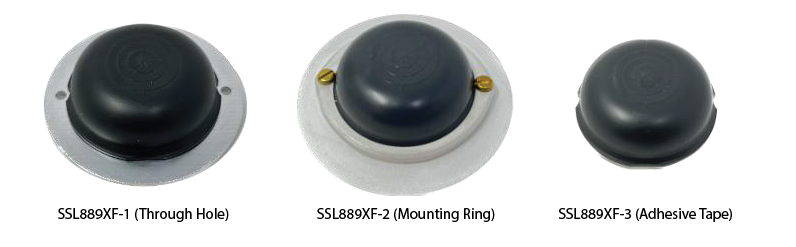
The SSL889XF antenna is available in three mechanical configurations. Configuration 1,2, and 3 as shown.
Features
- Very low noise preamp (2.5 dB)
- Axial ratio (< 2.0 dB typ.)
- Tight phase centre variation
- High-gain LNA (28 dB typ.)
- Low current (25 mA typ)
- ESD circuit protection (15 kV)
- Invariant performance from 2.5 to 16 VDC
- IP67, REACH, and RoHS compliant
Benefits
- Lightweight (45 g)
- Excellent RH circular polarized signal reception
- Great multipath rejection
- Increased system accuracy
- Excellent signal-to-noise ratio
- Industrial temperature range
TW7972XF Extended-Filter Triple-Band GNSS Antenna + L-Band
The TW7972XF is a precision-tuned surface mount triple-band Accutenna® technology antenna providing coverage for triple-band GPS/QZSS-L1/L2/L5, GLONASS-G1/G2/G3, Galileo-E1/E5a/E5b, BeiDou-B1/B2b/B2a, NavIC-L5, including the satellite-based augmentation system (SBAS) available in the region of operation [WAAS (North America), EGNOS (Europe), MSAS (Japan), or GAGAN (India)], plus L-Band correction services. It is especially designed for precision triple-frequency positioning.
Features
- Very low noise preamp (< 2.5 dB typ.)
- Low axial ratio (< 2.0 dB at zenith)
- Tight phase centre variation
- High-gain LNA (32 dB typ.)
- Low current (45 mA typ.)
- ESD circuit protection (15 kV)
- Invariant performance from 2.5 to 16 VDC
- IP67, REACH, and RoHS compliant
Benefits
- Excellent interference mitigation
- Excellent multipath rejection
- Increased system accuracy
- Excellent signal-to-noise ratio

